Caregiver Training Before Discharge: What to Ask the Rehab Team
Here’s something most families walk out of the hospital without knowing: the therapists working with your loved one can provide hands-on training specifically for you — for what caregiving is going to look like once you’re home. Almost nobody asks for it. And it’s one of the most valuable things available before discharge.
This post tells you what each member of the rehab team covers, what questions to ask, and how to make sure you get this training before it’s too late to ask.
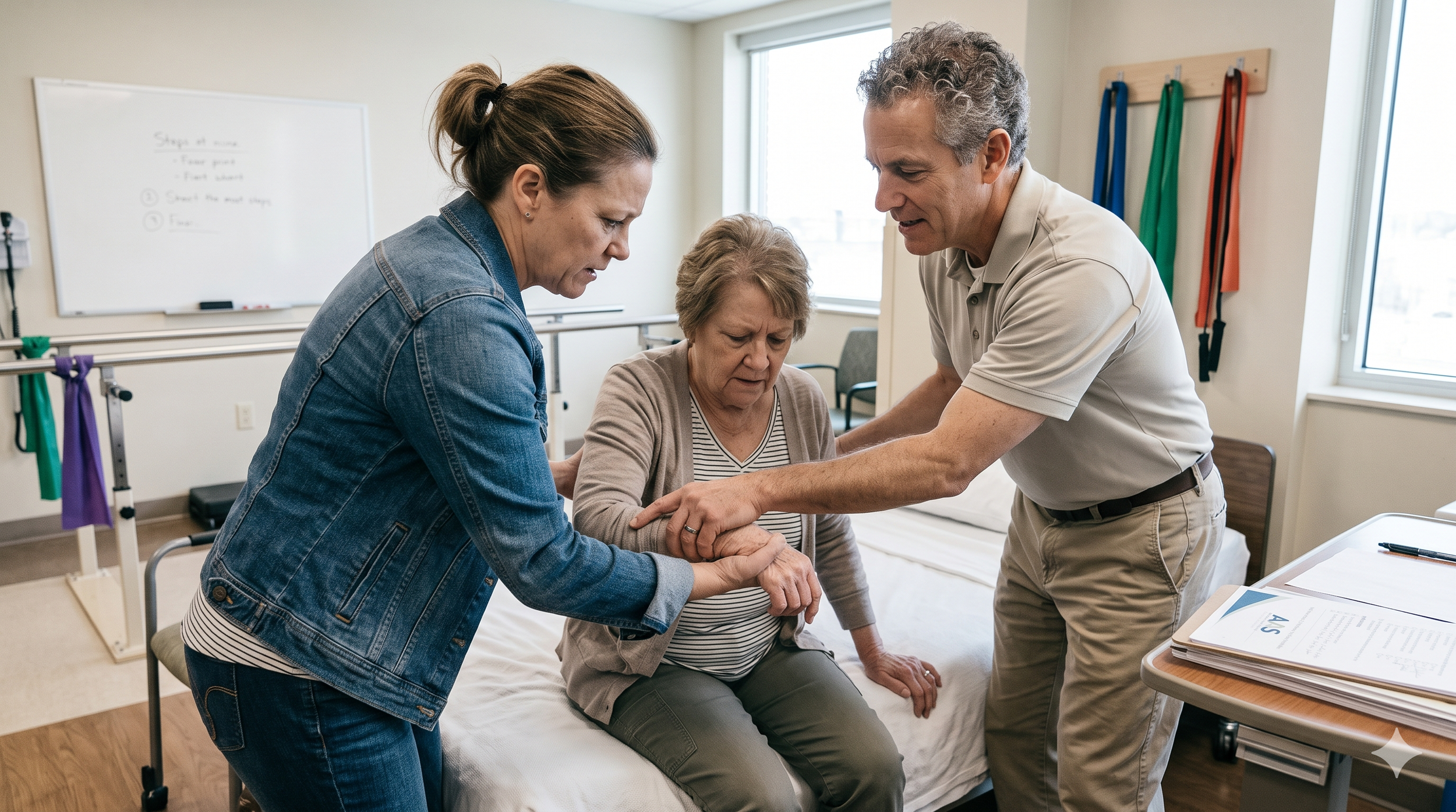
What the Rehab Team Does — and Why It Matters for You
When someone is hospitalized after a stroke, hip fracture, surgery, or serious illness, they’re often working with one or more rehabilitation therapists during their stay. Most families watch therapy happen from the hallway without fully understanding what each discipline does — or that the team has something specific and practical to offer caregivers before discharge.
Inpatient rehabilitation refers to the coordinated work of occupational therapists (OT), physical therapists (PT), and speech-language pathologists (SLP) to restore function, support safety, and prepare the patient — and ideally the family — for the transition home. Each discipline has a distinct focus. And each one has hands-on knowledge that directly applies to what you’ll be doing at home.
According to the NCOA, family caregivers provide the majority of post-discharge care for older adults in the United States. Inadequate caregiver preparation is one of the most consistent predictors of readmission within 30 days. The training exists. You just have to know to ask for it — and ask early enough for the team to plan around it.
What the Occupational Therapist Can Show You
The OT focuses on daily living — bathing, dressing, toileting, getting in and out of bed, and the practical safety of the home environment. Of the three disciplines, OT work is most directly connected to what caregiving looks like day-to-day.
What OT caregiver training typically covers:
1. Transfer technique — how to safely assist your loved one from bed to standing, from a chair, from a toilet, or in and out of a car. This is physical and technique-specific. Done incorrectly, it’s a risk to both the person you’re helping and to you.
2. Bathing and dressing assistance — the right way to help while preserving as much independence as possible. Which side to stand on, how to hand items over, how to cue rather than take over — these are learned skills, not common sense.
3. Equipment orientation — how to use, adjust, and position whatever is going home: walker, shower chair, grab bar, reacher, raised toilet seat. Receiving the equipment is not the same as knowing how to use it correctly.
4. Observations about the home — the OT has been watching your loved one move and function. They know what will likely be hardest once they’re back in their own environment. Ask directly: “Based on what you’ve seen, what should we be most prepared for at home?”
Ask the therapist before discharge:
• Can you walk me through the transfer technique and let me practice it before we leave?
• How should I be helping with bathing and dressing?
• Are there activities they should not do without someone right there?
• What equipment matters most, and can you show me how to use it correctly?
What the Physical Therapist Can Show You
The PT focuses on mobility — how your loved one walks, manages stairs, maintains balance, and moves safely through the home. What they’ve been working on in the gym directly shapes what the first week at home looks like.
What PT caregiver training typically covers:
5. Walking assistance technique — there is a right way to walk alongside someone using a walker or cane, and a common wrong way that actually increases fall risk. The PT can show you both so you know the difference.
6. Stairs — if the home has stairs, this is not optional. Ask the PT to walk through the correct technique and, ideally, practice it with your loved one before discharge.
7. Home exercise program — if exercises are being sent home, ask who is responsible for making sure they happen, what to do if an exercise causes pain, and what normal progress looks like.
8. What to do if they fall — know whether to help them up, call for help, or call 911. Know what signs mean 911 is the right answer. Ask this question even if it feels like preparing for failure. Especially then.
Ask the therapist before discharge:
• Can you show me the correct way to assist with walking?
• If they fall at home, what should I do?
• Are there surfaces or movements I should be particularly careful about?
• Should I be involved in the home exercise program?
What the Speech-Language Pathologist Can Show You
The SLP is the least familiar member of the team for most families — and the one whose instructions carry the most immediate safety risk if they’re missed or misunderstood. Speech-language pathologists work on communication, cognition, and swallowing. The swallowing piece is where caregiver knowledge matters most.
What SLP caregiver training typically covers:
9. Diet texture and liquid modifications — if your loved one has a swallowing impairment (called dysphagia), the SLP has recommended specific food textures and liquid consistencies. These are not preferences. They are safety guidelines. Giving someone with dysphagia the wrong texture can cause food or liquid to enter the lungs. That is a medical emergency.
10. Mealtime positioning and pacing — sitting fully upright, eating slowly, specific techniques like a chin tuck if that was recommended. These details are taught, not assumed.
11. Warning signs at mealtime — coughing during or after meals, a wet or gurgly voice quality after eating, repeated throat clearing, food pocketing in the cheek, or refusing to eat. These are signals to take seriously and report.
12. Communication strategies — if your loved one has word-finding difficulty or reduced comprehension after a stroke, the SLP may have specific approaches that make communication less frustrating for both of you.
Ask the therapist before discharge:
• Is there a swallowing restriction, and exactly what foods and liquids are permitted?
• What does a problem look like at mealtime, and when should I call for help?
• Are there communication strategies I should use at home?
• Has outpatient speech therapy been referred?
What Families Get Wrong About Rehab Training at Discharge
Reading the paperwork and calling it done.
Written instructions are a reference — not a substitute for supervised practice. Reading about a transfer and actually doing one with feedback is meaningfully different. Ask to practice, not just to observe.
Only one person attending.
If multiple people will be sharing caregiving responsibilities, multiple people need this training. Ask whether a sibling, spouse, or regular helper can be present for the caregiver education session. Most teams will welcome it.
Not asking what therapy goals were — or how close they got.
Before discharge, ask each therapist: “What was your goal for them, and where did they land?” That answer tells you exactly what your loved one can and cannot do right now, and what they’re still working toward. That context changes how you support them at home.
Assuming outpatient therapy is automatically arranged.
Inpatient therapy starts the process — it doesn’t finish it. Before discharge, confirm that outpatient referrals have been placed and that someone has made the first appointment. The transition window matters clinically. Don’t let it slip by in the logistics of getting home.
When You Need More Support After the Discharge
Even with good caregiver training, the home environment is different from the hospital. If you want help thinking through the home environment specifically — what to change, what to prepare, what to prioritize before they walk in the door — the Hospital-to-Home Transition Session at Adaptive Aging Solutions is designed for exactly this. It’s a 45-minute virtual educational consultation focused on your family’s specific situation. Educational guidance, not clinical services. Available nationwide. Book at adaptiveaging.solutions.
For families who want a practical organizational tool from day one, the Caregiver Quick Start Toolkit has seven fillable templates — medication tracker, care profile, daily schedule, emergency contacts, family meeting agenda, role assessment, and a caregiver self-care check-in. Available as an instant download at adaptiveaging.solutions.
Frequently Asked Questions About Rehab Caregiver Training
Can family members attend therapy sessions during a hospital stay?
Yes — and asking early makes a real difference. Most inpatient therapy teams can structure a caregiver education session if they have enough notice. Let the team know at the start of the stay that you want to be involved in discharge preparation. The day before discharge is often too late to plan for it.
What does an occupational therapist teach caregivers before discharge?
The OT focuses on the practical tasks of daily life — transfers, bathing, dressing, toileting, and equipment use. They can share clinical observations about what will likely be hardest at home, which is information that’s genuinely useful and not always offered unless you ask for it.
What does the physical therapist teach family caregivers?
The PT covers mobility: correct walking assistance, stair technique, the home exercise program, and fall response. If your loved one uses a walker or cane, the PT has already taught them the right technique — they can also teach you how to walk alongside them safely, which is a separate and important skill.
Why are the speech therapist’s discharge instructions so critical?
If swallowing has been affected — common after stroke, certain surgeries, or aspiration pneumonia — the SLP’s instructions carry direct safety implications. Specific food textures and liquid consistencies are not optional preferences. Not following them can result in aspiration, which is serious and potentially life-threatening.
What if my loved one didn’t receive therapy during their hospital stay?
Ask whether a therapy referral is appropriate. If your loved one came home with new limitations and therapy was not arranged, contact their primary care provider about a home health or outpatient therapy referral as soon as possible. The sooner it starts, the better the outcome tends to be.
The Team Wants to Prepare You — Let Them
The rehab team does not want to send your loved one home to a caregiver who is guessing. They have specific, practical knowledge that applies directly to your first week at home. It’s there. Ask for it before you leave the building.
Request a caregiver training session. Bring whoever else will be helping. Practice the transfers yourself. Write things down. And remember — the goal is not for you to become a therapist. It’s for you to feel prepared for the role you’re actually stepping into.
Educational Disclaimer: This content is for general educational purposes only. It does not constitute medical advice, clinical guidance, or professional healthcare services. Hospital-to-Home Transition Sessions and Home Safety Strategy Sessions provided through Adaptive Aging Solutions are educational consultations only — not occupational therapy or medical services. For clinical guidance specific to your loved one’s situation, please consult their healthcare team.
