How to Make a Bathroom Safe for Your Elderly Parent
If you've ever watched a parent grip the towel bar for support getting out of the tub — or noticed they've started avoiding the shower — you're not imagining things. Your instincts are right. The bathroom is the most dangerous room in the home for older adults, and it's the place where most families wish they had acted sooner.
I'm Alissa, a Licensed Occupational Therapist with over 8 years of experience in promoting safety, independent living and aging-in-place. In that time, I've seen what works, what families overlook, and which small changes make an enormous difference. This post walks you through exactly what to look for — and what to do about it — in plain language you can act on today.
Why Bathroom Falls Are So Dangerous for Seniors
Bathroom falls are the leading cause of fall-related injury in older adults — and most of those falls are preventable. According to the CDC, nearly 3 million older adults are treated in emergency departments each year for fall injuries, and bathrooms are among the most common locations. What makes them so risky isn't age alone — it's the specific combination of wet surfaces, the physical demand of transitioning between positions (seated to standing), and a near-total absence of anything safe to grab.
As an OT, I've seen this pattern over and over. The danger isn't just slipping in the shower. It's the moment of pushing up from the toilet. It's stepping over the tub edge while your balance is already working hard. It's a 3 a.m. trip to the bathroom in the dark with nothing between you and the floor. These transitions are where injuries happen — and they're exactly where targeted modifications make the biggest difference.
Bathroom fall prevention for seniors refers to a set of practical environmental changes — safety equipment, lighting adjustments, and layout modifications — that reduce the physical demands and fall risk inherent in daily bathroom use. Done right, these changes are nearly invisible and they preserve independence.
The 5 Most Important Bathroom Safety Upgrades
These are the modifications that matter most. Start here before anything else.
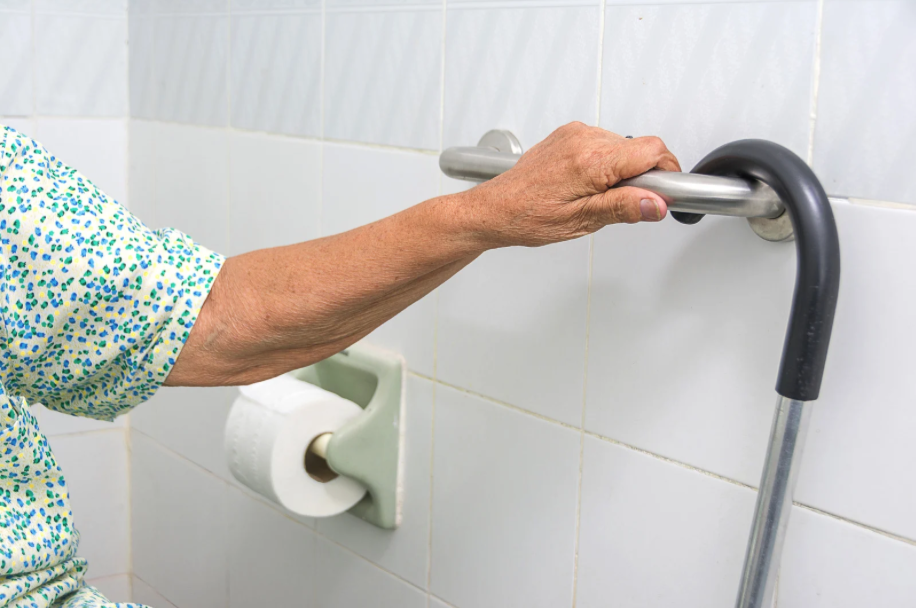
1. Install grab bars — properly. Grab bars beside the toilet and inside the shower or tub are the single highest-impact change you can make. They need to be wall-stud mounted or installed with specialty anchors. This is a critical point families miss: standard towel bars are not grab bars. They are not engineered to hold body weight, and they will pull out of the wall. If your parent grabs one during a stumble, it creates a fall rather than preventing one. If you're not comfortable with the installation, hire a handyperson. This one is worth doing correctly.
2. Add a non-slip surface inside the shower and outside the tub. A non-slip mat inside the shower and a bath mat with non-slip backing on the floor outside the tub close two of the most common injury gaps quickly. Replace these as soon as they show any peeling or wear — an old mat is often worse than no mat at all.
3. Add a shower chair or bench. This is the modification families resist the most, and it's one of the most impactful. Seated bathing dramatically reduces fall risk by removing the need to stand and balance simultaneously — which is genuinely hard work for an aging body. A shower chair doesn't mean your parent has "declined." It means they're bathing safely.
4. Install a handheld showerhead. A handheld showerhead with a long, flexible hose allows seated bathing and eliminates the need to move around under a fixed stream. It's an inexpensive upgrade — typically $30–$60 — and most can be installed without a plumber.
5. Improve nighttime lighting. A significant portion of serious bathroom falls happen at night. Motion-sensor nightlights in the hallway and bathroom mean your parent doesn't have to navigate in the dark or fully wake up to find a light switch. Walk the path from the bedroom to the bathroom yourself tonight with the lights off. That tells you everything.
Step-by-Step: How to Walk Through the Bathroom With Fresh Eyes
You don't need to hire anyone to do this initial review. Here's how to approach it:
Stand at the bathroom entrance and look at the floor. Is there a rug without secure non-slip backing? Remove it or replace it today.
Walk to the toilet. Can your parent stand up unaided without using the vanity or the wall? Reach out and touch the walls — is there anything safe to hold? If not, a toilet grab bar or a raised toilet seat with arms is worth considering.
Step into the shower or tub area. Is there anything to hold onto while stepping over the tub edge? Is the floor inside the shower non-slip? Is a shower chair available?
Check the lighting. Is there a nightlight? Is the light switch reachable from the doorway without walking across the room first?
Check the water temperature. The CDC recommends setting water heaters to 120°F or below to prevent scalding — a real risk when sensation and reaction time have changed with age.
Look at towel placement. Are standard towel bars where someone might grab them for support? If so, replace them with grab-bar rated options — or make sure they're clearly not something to hold onto.
Common Mistakes Families Make (and What to Do Instead)
Relying on suction-cup grab bars for full support. Suction grab bars exist and have their place — but they are for light balance assistance only. If your parent puts significant body weight through a suction bar and it releases, the result is a fall with nothing to slow it. For primary support, use stud-mounted bars.
Installing grab bars at the wrong height. A grab bar that's too high or too low is nearly as unhelpful as no bar at all. For beside the toilet, the standard guide is 33–36 inches from the floor. For the shower, placement depends on your parent's height and how they use the space. This is where a professional eye can make a real difference.
Assuming "they've been fine so far." This is the sentence I hear most often before something happens. The bathroom doesn't get more dangerous — your parent's balance, strength, and reaction time change gradually, often without either of you noticing. By the time a near-miss happens, the risk has usually been building for months.
Buying equipment but not using it. A shower chair still in the box doesn't help anyone. If your parent resists using equipment, have an honest conversation about independence — equipment that reduces fall risk is what keeps them living at home, doing things their way.
When to Get More Help with Bathroom Safety
Some situations benefit from a more thorough look than a solo walkthrough provides. Consider getting additional guidance if:
Your parent has experienced a recent fall or near-fall
They have significant balance, vision, or strength changes
You're caring from a distance and can't assess the space yourself
You're not sure which modifications are most important for your parent's specific situation
You're preparing the home for a discharge from a hospital or rehab stay
A Home Safety Strategy Session with Adaptive Aging Solutions is a 45-minute virtual educational consultation — available nationwide — where we walk through your family's specific situation, identify the highest-priority changes, and help you leave with a clear direction. No referrals needed, no insurance required. Just practical guidance from someone who knows what they're looking at.
You can also start for free. Our 5 Most Dangerous Fall Hazards in Your Home checklist covers the bathroom and four other high-risk areas — it's a quick, actionable starting point and it's free to download at adaptiveaging.solutions.
Frequently Asked Questions About Bathroom Safety for Elderly Parents
How do I know if my elderly parent's bathroom is safe? Walk through it as if you were your parent — at night, without turning on the overhead light first. Look for: anything without a non-slip surface, transitions that require balance (stepping over a tub edge, rising from the toilet), and the absence of anything stable to hold. If there are no grab bars and no non-slip surfaces, those are the two most urgent priorities. Our free fall hazards checklist is a helpful starting guide.
Where should grab bars be placed in a bathroom for elderly? For toilet safety, a horizontal grab bar mounted 33–36 inches from the floor alongside the toilet is the standard starting point. In the shower, placement depends on how the person enters and moves — but a horizontal bar at hand height for entering and a vertical or angled bar for balance while standing are the most common combination. Bars must be mounted into wall studs or with specialty anchors rated for body weight.
Is a shower chair necessary for aging parents? Not always — but it becomes important when standing in the shower requires significant effort, when balance has become less reliable, or when recovery from illness or surgery has reduced strength. For many older adults, seated bathing removes the highest-risk moments of a shower. It's a practical safety tool, not a sign of significant decline.
Can I install grab bars myself or do I need a professional? Many people successfully install grab bars themselves with a stud finder and basic tools — and there are excellent tutorials available. The most important thing is that the bar is anchored into wall studs or with the correct toggle anchors for hollow walls. If you're uncertain, a handyperson with grab bar experience is a worthwhile hire. An incorrectly installed bar that fails during a fall attempt is dangerous.
What is the most dangerous part of the bathroom for elderly adults? The bathtub entry and the toilet transition are the two highest-risk moments in bathroom use for older adults. Both require significant balance and lower-body strength to move between seated and standing positions — on surfaces that are often wet or slick. Nighttime bathroom trips add the dimension of low lighting and being less fully awake. Addressing these three areas — tub entry, toilet rise, and nighttime lighting — covers the majority of bathroom fall risk.
You Already Know Something Needs to Change
If you've read this far, it's because someone you love is at risk — or because you've already had a scare and you want to make sure it doesn't happen again. That instinct is worth listening to.
The good news is that most bathroom fall risks are fixable. Many of them are inexpensive. Almost none require major construction. They just require knowing what to look for — and following through.
Start with the free fall hazards checklist at adaptiveaging.solutions, or grab the Home Safety Checklist Bundle for a complete room-by-room walkthrough designed by a Licensed OT. And if you want a knowledgeable guide to help your family sort through priorities, we're here.
You're doing the right thing by getting informed. That matters more than you know.
Educational Disclaimer: This content is for general educational purposes only. It does not constitute medical, clinical, or professional advice, and is not a substitute for individualized guidance from a licensed healthcare provider. Home Safety Strategy Sessions provided through Adaptive Aging Solutions are educational consultations only — not occupational therapy or medical services. For questions about your loved one's specific medical, functional, or safety needs, please consult with their healthcare team or appropriate licensed professionals.
